
Artificial Intelligence, or AI, has quickly moved from the world of science fiction into our everyday lives. In 2026, AI is no longer just about robots or futuristic machines. It is being used to study, create, communicate, work, solve problems, and even manage businesses. From an AI assistant helping a student understand a difficult lesson to an AI system helping a company automate hundreds of tasks, the technology is changing how people use their time and skills.
The growth of AI has also created a new generation of tools and life hacks. Understanding these tools can help people work smarter, learn faster, and explore new possibilities. However, the real power of AI comes from knowing how to use it responsibly and combining it with human creativity and judgment.
1. Best AI Tools
There are hundreds of AI tools available in 2026, but different tools are designed for different purposes. Some focus on conversation and research, while others specialize in writing, design, coding, images, video, or productivity.
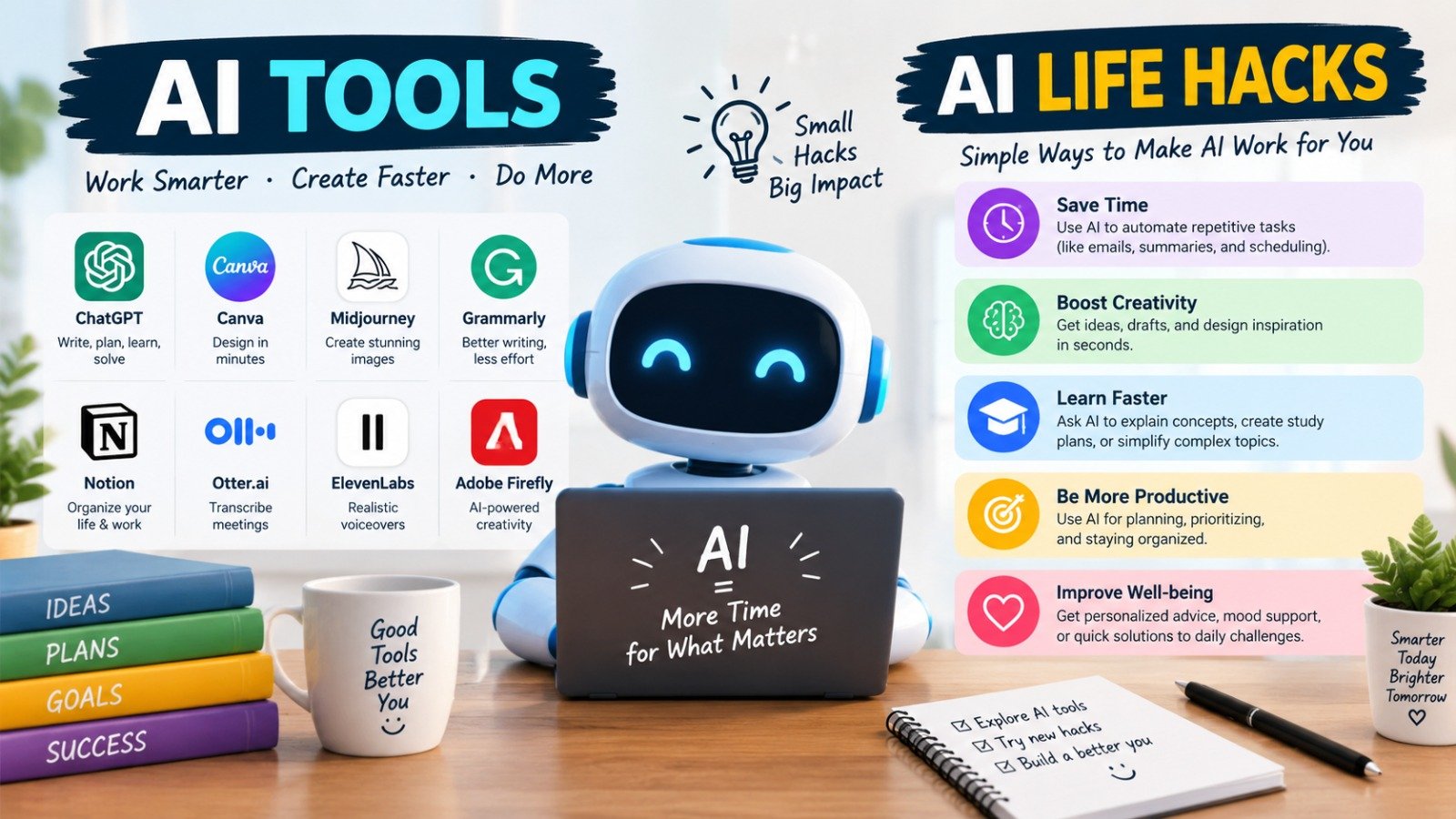
ChatGPT is a versatile AI assistant that can help users brainstorm ideas, explain difficult subjects, summarize information, create plans, and improve writing. Students can use it as a study companion, while professionals can use it for planning and productivity.
Google Gemini is another AI assistant that can support research, writing, reasoning, and other digital tasks. Microsoft Copilot provides AI assistance within Microsoft’s productivity ecosystem and can support users working with documents and other business tasks.
For design and creativity, Canva’s AI features can help users create presentations, posters, graphics, and other visual content. There are also specialized AI tools for image generation, video creation, coding, music, research, and communication.
There is no single AI tool that is “best” for everyone. The most useful tool depends on the user’s goal. A student may need an educational assistant, while a designer may need an image-generation tool and a business may require automation software.
2. New AI Tools
AI is developing at an incredible speed, with new tools and features appearing regularly. One of the biggest developments is multimodal AI. Instead of working only with text, modern AI systems can increasingly understand combinations of text, images, audio, video, and documents.
Another important development is AI agents. Traditional software usually waits for instructions before performing a specific action. AI agents can be designed to understand a goal, decide what steps are required, use available tools, and complete a sequence of tasks.
AI is also becoming easier for ordinary people to use. Tasks that once required technical knowledge can increasingly be performed through simple natural-language instructions. This means that people do not necessarily need to be expert programmers to experiment with AI.
However, a new tool is not automatically the right tool. Users should consider factors such as accuracy, privacy, reliability, cost, and ease of use before adopting an AI service.
3. AI Tools for Business Operations
AI is transforming the way businesses manage their everyday operations. Companies are using AI not only for content creation but also for automation, customer service, product development, data management, marketing, and teamwork.
Workflow automation helps businesses eliminate repetitive manual tasks by connecting different applications. Tools such as n8n and Zapier can automatically move information between applications, send notifications, update records, and trigger actions when specific events occur. This can save employee time and reduce manual errors.
AI agents take automation further. They can analyze a situation, understand a goal, decide what actions are needed, and use different tools to complete multi-step tasks. Frameworks such as CrewAI, AutoGen, LangGraph, and LangChain can be used to develop agent-based systems.
Multimodal AI is also valuable to businesses because companies work with many types of information. Tools such as ChatGPT, Gemini, Claude, and Grok can work with different forms of content, including text, images, documents, and other media.
Another important technology is Retrieval-Augmented Generation (RAG). RAG allows an AI system to retrieve relevant information from an organization’s documents or databases before generating a response. Tools and technologies such as LlamaIndex, LangChain, vector databases, and Haystack can support these systems.
AI is also being used in product development. Tools such as Bubble, Lovable, Cursor, and Windsurf can assist teams in building applications and experimenting with AI-powered features.
In marketing and communication, AI video, voice, and avatar technologies are becoming increasingly useful. Tools such as Runway, Veo, Sora, ElevenLabs, and HeyGen can assist with video production, synthetic voices, and digital avatars. Businesses can use these technologies for advertisements, training material, demonstrations, and other forms of content, while respecting consent and intellectual-property requirements.
Finally, connected workspaces and AI monitoring tools help organizations manage projects and evaluate AI systems. Platforms such as Notion and ClickUp can organize tasks and information, while tools such as PromptLayer, Helicone, and TruLens can help teams monitor AI quality, usage, and costs.
The biggest business advantage does not come from using the largest number of AI tools. It comes from selecting the right technology for a specific problem and combining it with human expertise.
4. AI Life Hacks
AI can also make everyday life easier through simple techniques known as AI life hacks.
One useful hack is turning long notes into short revision material. Instead of reading several pages repeatedly, users can ask AI to organize information into key points, flashcards, summaries, or practice questions.
Another useful trick is creating a personal timetable. By providing deadlines, priorities, and available study or work hours, users can ask AI to divide a large workload into smaller tasks.
AI can also help with travel planning, shopping lists, meal ideas, emails, checklists, and brainstorming. One of the most effective techniques is the “break it down” method. If a task seems overwhelming, ask AI to divide it into smaller steps.
The quality of the result often depends on the quality of the instruction. Instead of saying, “Make notes,” a user can specify the desired length, audience, format, and purpose. Clear instructions generally make AI outputs more useful.
5. AI for Students and the Future
Education is one area where AI can become a powerful learning partner. Students can use AI to understand difficult topics, generate practice questions, test their knowledge, improve writing, and explore subjects from different perspectives.
For example, a student studying science could ask AI to explain a difficult concept using an everyday example. They could then ask for a short quiz to test whether they actually understood it.
However, AI should support learning rather than replace it. Copying answers without understanding them may save time but does not build knowledge. Students should also verify important information because AI can sometimes produce inaccurate or outdated answers.
Looking ahead, AI is likely to become even more integrated into education, workplaces, creative industries, and everyday technology. AI assistants may become better at handling complex tasks, while businesses may use intelligent systems to automate processes and analyze information.
At the same time, responsible AI use will become increasingly important. Privacy, misinformation, copyright, bias, security, and the accuracy of AI-generated information are issues that users and organizations will need to consider.
Conclusion
AI in 2026 is much more than a collection of clever applications. It is becoming a new way of interacting with technology. The best AI tools can help people learn, create, organize, research, and communicate. New AI systems are making technology more capable, while business tools are transforming how companies operate.
AI life hacks can save time on everyday tasks, and students can use AI as a tutor, practice partner, and brainstorming assistant. Businesses can use automation, AI agents, RAG systems, multimodal tools, and monitoring platforms to improve their operations.
But the most important AI skill is not simply knowing which tool to use. It is knowing when to use AI, how to question its results, and when human judgment should take the lead.
AI can generate ideas, organize information, and perform tasks at remarkable speed. But humans provide curiosity, creativity, responsibility, and purpose. The future of AI will therefore not simply be about machines doing more—it will be about people learning to work smarter with machines.