


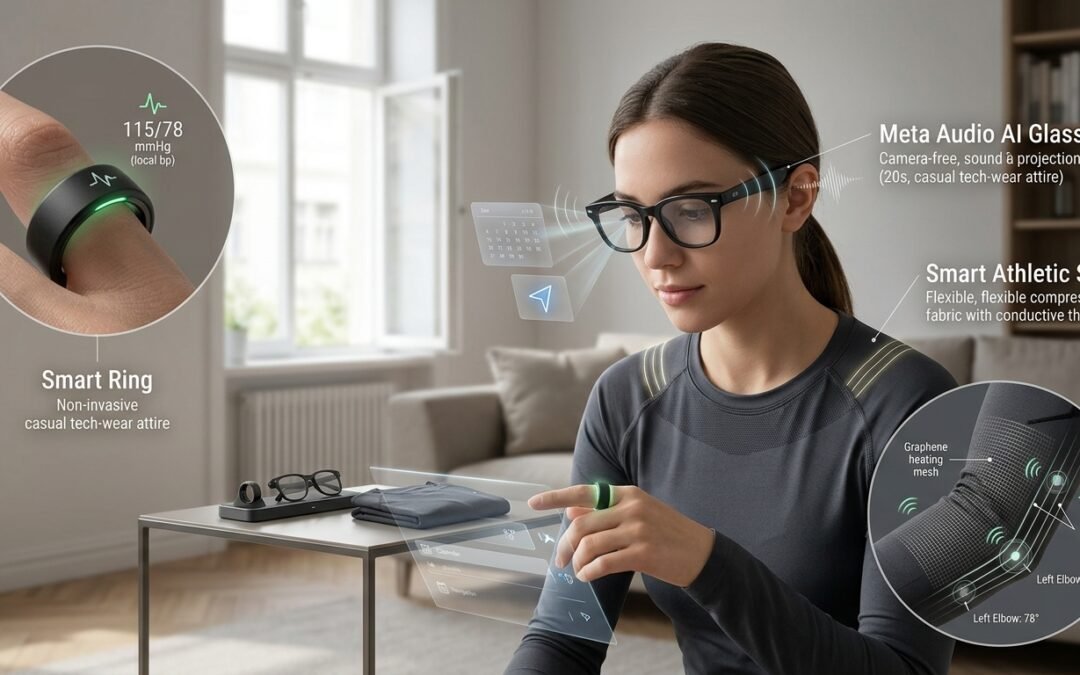
The wearable tech market is officially moving past the wrist, driven by micro-sensors and localized artificial intelligence embedded in everyday items. Advanced computing is migrating directly into smart rings, camera-free eyewear, and flexible e-textiles.
Here are the most significant articles, discoveries, and product developments shaping the future of wearables beyond smartwatches.
1. Smart Rings: Streamlined Screen-Free Monitoring
Smart rings are capturing immense industry traction by providing high-fidelity tracking without the distraction of a glowing digital display panel.
Continuous Micro-Telemetry: According to specialized tech reviews, smart rings are upgrading their photoplethysmography (PPG) arrays to measure arterial pulse wave velocity. This tech discovery allows the band to calculate continuous, cuffless blood pressure estimates directly from the finger, avoiding the need for bulky inflating arm cuffs.
Proactive Metabolic Tracking: The latest standalone rings monitor micro-temperature shifts and blood oxygen variations locally on the device, mapping out cardiovascular trends, stress spikes, and sleep recovery windows without draining massive amounts of battery power
2. Audio Eyewear & Decoupled Spatial AR Glasses
Smart eyewear is successfully splitting into two high-value categories: minimalist audio tools and ultra-lightweight spatial displays.
Privacy-First Audio Glasses: New form factors, such as the recently debuted Meta Audio AI Glasses, purposely remove physical video cameras to eliminate public filming pushback. Starting at an accessible $249, they utilize directional, open-ear audio speakers and localized microphone arrays to deliver hands-free GPS navigation and real-time audio language translation.
100-Gram Spatial Hardware: True Augmented Reality (AR) glasses have conquered heavy headset fatigue by separating the core computing components. By offloading the battery and processor onto a discrete pocket puck, engineering teams have dropped the physical weight of 5K spatial eyewear down to just 100 grams, facilitating comfortable, all-day heads-up virtual multi-tasking.
3. Smart Textiles & Biomechanical Apparel
Tech discoveries are successfully integrating conductive computing threads right into flexible fabric weaves, transforming standard clothes into responsive sensory networks.
Haptic Form Correction:Premium athletic compression wear now integrates flexible polymer lines that act as digital joints. Paired with onboard movement algorithms, the fabric registers exact physical angles, providing immediate physical haptic vibrations to help athletes or physical therapy patients adjust their body form instantly.
Autonomous Climate Control:High-utility outdoor outerwear features micro-thin graphene heating meshes. Rather than forcing users to toggle high, medium, or low switches, built-in ambient sensors read real-time external wind chill alongside changing core body heat to dynamically adjust the jacket’s interior warmth completely autonomously.